
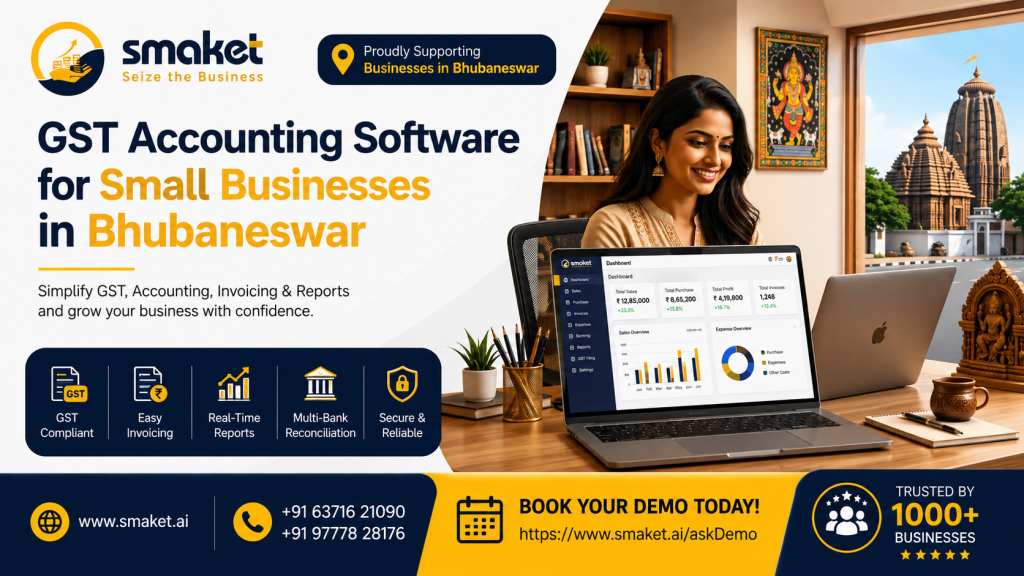
Running a small business in Bhubaneswar means managing several activities every day. A retailer may need to create invoices, record purchases, monitor stock and follow up on customer payments. A distributor may also need to manage suppliers, sales orders, inventory and business accounts.
As the number of transactions increases, managing these activities through notebooks, spreadsheets or separate applications can become time-consuming. It can also make it harder to maintain consistent records and quickly understand the financial position of the business.
This is where GST accounting software for small businesses in Bhubaneswar can make a practical difference.
A suitable accounting system can bring billing, sales, purchases, expenses, inventory and financial records into a more organised workflow. It can help business owners reduce repetitive data entry, access transaction information more easily and keep their day-to-day operations structured.
However, choosing accounting software should not be based only on the number of features advertised. Small businesses should consider their GST and billing requirements, industry, transaction volume, inventory needs, reporting requirements, ease of use and ability to scale.
For businesses comparing their options, it is also useful to understand what makes accounting software suitable for a small business before selecting a solution.
What Is GST Accounting Software for Small Businesses?
GST accounting software is software that combines accounting and business transaction management with GST-related billing and record-keeping capabilities.
Instead of maintaining sales invoices, purchase records, expenses and financial information separately, businesses can use an integrated system to organise these activities.
Depending on the software and business requirements, a GST accounting system may help manage:
- Sales transactions
- Purchase transactions
- GST invoices
- Customer accounts
- Supplier records
- Expenses
- Payments and receipts
- Inventory
- Business reports
- Accounting records
For a small business, the main advantage is having business information organised in a structured digital environment.
GST accounting software does not replace the official GST system or professional tax advice. Businesses remain responsible for meeting applicable tax and compliance requirements. Software can instead help maintain accurate transaction records and support relevant accounting and GST-related workflows. Businesses should verify current GST requirements through the official GST portal before making compliance-related decisions.
Why Is GST Accounting Software Important for Businesses in Bhubaneswar?
Bhubaneswar has businesses operating across retail, wholesale, distribution, services and other sectors. While their operations differ, many of these businesses share a common requirement: keeping accurate records while managing daily transactions efficiently.
For a growing business, accounting is not only about recording income and expenses. It is also connected with invoicing, purchases, payments, inventory and customer accounts.
Better organisation of financial records
- A digital accounting system can help businesses maintain sales, purchases, expenses and other transactions in a structured format.
- Instead of searching through multiple registers or spreadsheets, business owners can access relevant information from the accounting system.
More efficient GST billing
- Creating invoices manually can become repetitive when a business handles a large number of transactions.
- GST-enabled billing software can help businesses create invoices with the required transaction and tax information according to their business setup.
Easier tracking of sales and purchases
- A small business needs to understand how much it is selling and what it is purchasing.
- Recording these transactions systematically can make it easier to review business activity and identify trends.
Better visibility into payments
- Businesses often sell products or services on credit. Organised customer records can make it easier to identify outstanding amounts and follow up on pending payments.
More connected inventory management
- For retailers and distributors, accounting cannot always be separated from stock management.
- When sales and purchases affect inventory, having these activities within a connected workflow can help reduce inconsistencies between stock and business records.
What Problems Do Businesses Face Without GST Accounting Software?
Manual accounting can work for a very small number of transactions, but it can become difficult as a business grows.
1. Repetitive data entry
Entering the same transaction information into multiple spreadsheets or registers takes time and increases the possibility of inconsistent records.
2. Difficult invoice tracking
Finding an old invoice, checking a customer’s purchase history or reviewing a particular transaction can be difficult when records are scattered across different files.
3. Unorganised purchase information
Businesses dealing with multiple suppliers may find it difficult to maintain a clear view of purchases when information is recorded manually.
4. Outstanding payment issues
When customer credit transactions are not tracked systematically, business owners may have difficulty identifying which payments are pending.
5. Stock and accounting discrepancies
Retailers and distributors need to know what has been sold, what has been purchased and what remains in stock. Separate systems can make reconciliation more difficult.
6. Time-consuming reports
Preparing sales, purchase, expense and other business reports manually can take considerable time.
7. Difficulty maintaining consistent records
As transaction volumes increase, manual processes can make it harder to maintain complete and organised financial information.
How Does GST Accounting Software Solve These Problems?
The right accounting software can create a more connected workflow for everyday business activities.
Key ways it can help include:
- Organised transaction records: Maintain business transactions in a central system.
- GST billing: Create GST-related invoices according to the business’s requirements.
- Faster invoicing: Reduce repetitive work involved in preparing invoices.
- Sales tracking: Maintain organised records of sales transactions.
- Purchase management: Record and review purchases from suppliers.
- Customer management: Keep customer-related transaction information accessible.
- Supplier management: Organise supplier and purchase information.
- Inventory visibility: Connect stock-related activities with sales and purchases where supported.
- Business reporting: Review important information through relevant reports.
- Reduced duplication: Minimise the need to maintain identical information across disconnected systems.
- Searchable records: Make historical transactions easier to locate and review.
The purpose is not simply to automate individual tasks. The bigger benefit is creating a more structured process for managing business information.
What Are the Benefits for Small Businesses and SMEs?
Saves time on routine work
Automating repetitive billing and accounting activities can reduce the amount of time spent on administrative tasks.
Provides better business visibility
When sales, purchases, expenses and payment information are organised, business owners can get a clearer picture of how the business is performing.
Supports growing transaction volumes
A business that starts with a few daily transactions may eventually manage a much larger customer base and higher invoice volume. Digital accounting software can provide a more organised way to manage increasing amounts of information.
Helps retailers manage daily operations
Retail businesses typically deal with frequent sales, purchases and inventory movements. Connecting these activities can make daily record-keeping easier.
Supports distributors and wholesalers
Distributors and wholesalers may need to manage multiple suppliers, customers, products and transactions. An integrated accounting workflow can help organise these activities.
Makes information easier to access
Digital records can be searched, reviewed and analysed more easily than paper-based records.
Helps business owners make informed decisions
Accurate and accessible business information can help owners understand sales, expenses, receivables, purchases and other operational areas.
How Should You Choose GST Accounting Software?
The right software depends on the individual business. Before choosing a solution, consider the following factors.
Does it support your accounting requirements?
Check whether the software supports the accounting activities your business performs, including sales, purchases, expenses, receipts, payments and reporting.
Does it support your GST billing requirements?
The software should support the GST-related invoicing and transaction workflows relevant to your business.
Because GST requirements can change, businesses should also verify current rules and procedures through official sources.
Does it support inventory?
If your business sells physical products, check whether the software can manage the inventory workflows you actually need.
This is particularly important for retailers, wholesalers and distributors.
Is it easy for your team to use?
Software should make business management easier, not create another complicated process.
Consider how easily employees can learn the system and perform common tasks.
Does it provide useful reports?
Look for reports that help you understand business performance and financial information.
Can it grow with your business?
The requirements of a small business can change as sales increase, new products are added and the team expands.
Choose software that can support your future requirements where possible.
What support is available?
Consider onboarding, training, technical support and other assistance that may be important when moving from manual accounting to software.
Why Is Smaket a Smart Choice for Small Businesses?
Smaket is designed as a business software solution for organisations looking to manage important business activities through a digital platform.
For a small business, the value of accounting software is not simply the ability to create an invoice. The software should fit into the wider workflow of the business.
That means businesses should consider how Smaket fits their requirements for accounting, billing, inventory and day-to-day business management.
For example, a retailer in Bhubaneswar may need to record daily sales, manage purchases, track products and maintain business accounts. A distributor may have different requirements involving suppliers, customers, stock and transaction records.
Rather than choosing software based on a generic feature list, businesses should evaluate whether the available Smaket capabilities match their specific workflow.
What should businesses consider before choosing Smaket?
Businesses can ask:
- Does Smaket support the accounting activities my business performs?
- Does it support my billing and GST-related requirements?
- Can it handle my inventory workflow if I sell physical products?
- Are the available reports useful for my business?
- Can my team learn and use the software efficiently?
- Can it support my business as transaction volumes increase?
This approach helps businesses evaluate accounting software based on actual operational requirements rather than choosing a product solely because it is marketed as “the best.”
A real-world example
Consider a small retail shop in Bhubaneswar that sells several categories of products every day.
The owner needs to create invoices, record purchases, monitor stock, track customer payments and understand daily sales.
If billing is maintained in one application, inventory in a spreadsheet and accounting records in another system, the owner may need to enter or verify the same information multiple times.
With an integrated business-management workflow, these activities can be organised more systematically.
For the business owner, the benefit is not only faster billing. It can also mean easier access to business information and less time spent switching between disconnected records.
FAQ:
1. What is GST accounting software?
GST accounting software combines accounting and business transaction management with GST-related billing and record-keeping capabilities. It can help businesses organise sales, purchases, invoices, expenses and financial information.
2. Do small businesses in Bhubaneswar need GST accounting software?
It depends on the business’s size, GST registration status, transaction volume and accounting requirements. Small businesses can benefit from organised digital records when their daily transactions become difficult to manage manually.
3. What features should I look for in GST accounting software?
Look for accounting, GST billing, invoicing, sales and purchase management, reporting, inventory capabilities where required, customer and supplier management, ease of use and suitable support.
4. Can GST accounting software manage inventory?
Many accounting and business-management platforms provide inventory functionality. Retailers, wholesalers and distributors should check whether the software supports the stock-related processes their business requires.
5. Is GST accounting software useful for retailers?
Yes. Retailers often need to manage billing, sales, purchases, inventory and accounting together. A connected system can help organise these activities more efficiently.
6. What is the difference between GST billing software and GST accounting software?
GST billing software generally focuses on invoicing and billing transactions. GST accounting software typically covers a broader range of activities, including accounting records, sales, purchases, expenses and reporting.
7. Does accounting software automatically make a business GST compliant?
No. Software can help businesses maintain records and support relevant workflows, but it does not remove the business’s responsibility to meet applicable GST requirements. Businesses should verify current rules through official GST resources or consult a qualified professional.
8. Is Smaket suitable for small businesses?
Smaket can be evaluated by small businesses based on their accounting, billing, inventory and business-management requirements. Businesses should review the current product capabilities and determine whether they match their specific operational needs.
Conclusion
For small businesses in Bhubaneswar, managing GST-related records is only one part of running an efficient business. Sales, purchases, billing, expenses, customer payments, inventory and accounting are closely connected in everyday operations.
GST accounting software can help bring these activities into a more organised digital workflow, reducing repetitive work and making important business information easier to access.
The right solution should fit the way a business actually operates. Before choosing software, consider GST and billing requirements, accounting features, inventory needs, reporting, ease of use, support and future scalability.
For retailers, distributors, wholesalers and SMEs looking for a digital business-management solution, Smaket is worth evaluating based on its current features and how well they match the business’s requirements.
Businesses can also explore the broader accounting software options in Bhubaneswar before making a decision.