
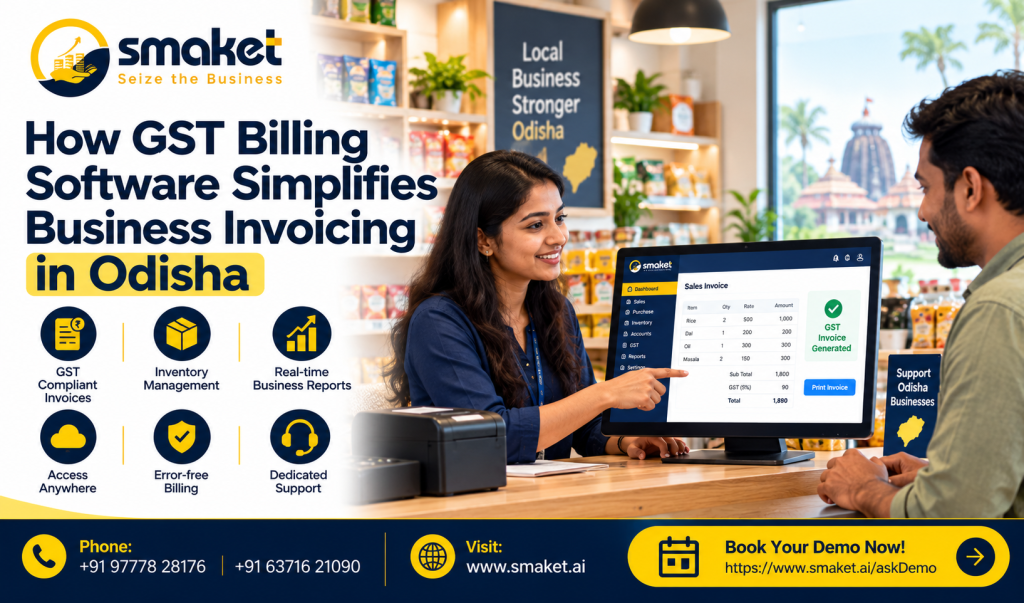
Managing invoices is an important part of running a business. Whether you operate a retail shop in Bhubaneswar, a grocery store in Cuttack, a pharmacy in Rourkela, or a wholesale business in Sambalpur, accurate billing helps you maintain organised sales records and manage daily transactions efficiently.
However, preparing invoices manually can become time-consuming as the number of customers, products, and sales increases. Business owners may also need to calculate applicable GST, maintain purchase records, track payments, and prepare reports.
GST billing software in Odisha helps businesses simplify these tasks by organising invoice generation, tax calculations, and transaction records in a digital system. With suitable software, businesses can reduce repetitive work, improve recordkeeping, and manage their invoicing processes more efficiently.
In this blog, we will explore how GST billing software simplifies business invoicing, which features to look for, and how Smaket can help businesses organise their billing operations.
What Is GST Billing Software?
GST billing software is a digital tool that helps businesses prepare invoices and maintain transaction records related to the Goods and Services Tax (GST) system in India.
Depending on its features, the software may help businesses:
- Generate sales invoices.
- Calculate applicable taxes using configured tax rates.
- Maintain customer and product details.
- Record sales and purchases.
- Track payments and outstanding balances.
- Organise GST-related reports.
- Manage inventory alongside billing.
For businesses that handle multiple transactions daily, software can make invoicing more consistent and reduce the need for repeated manual calculations.
Businesses should select software based on their specific invoicing and compliance requirements. For official information, refer to the CBIC GST Invoice Rules.
Why Is GST Billing Software Important for Businesses in Odisha?
Businesses across Odisha operate in different industries, including retail, wholesale, distribution, pharmacy, electronics, garments, and food services. Although their operations vary, many need to prepare invoices, maintain transaction records, and monitor payments.
Manual billing can become difficult when businesses handle large product catalogues, frequent sales, and multiple tax rates. Separate registers and spreadsheets can also make it harder to retrieve previous invoices or review sales information.
GST billing software brings these activities into a more organised workflow. It can help businesses maintain digital records, generate invoices efficiently, and review transactions when needed.
For small and growing businesses, these improvements can save time and support better day-to-day management.
7 Ways GST Billing Software Simplifies Business Invoicing
1. Generates Invoices Faster
Preparing each invoice manually requires entering product details, quantities, prices, and applicable taxes. Repeating this process for every transaction can slow down billing, particularly during busy hours.
GST billing software allows businesses to save product information and use it when preparing invoices. Depending on the available features, users can select products, enter quantities, calculate invoice totals, and generate bills through a structured process.
For example, a grocery store in Bhubaneswar can use saved product details to prepare customer bills more efficiently instead of entering the same information repeatedly.
Benefit: Faster invoice preparation and less repetitive data entry.
2. Helps Calculate Applicable GST
Businesses may sell products or services with different GST treatments. Calculating tax manually can increase the risk of errors, especially when staff handle many transactions.
Billing software can calculate tax using the rates and settings configured for products or services. However, users must ensure that the product classification, applicable tax rate, exemptions, and transaction details are correct.
For example, a retailer selling products with different tax rates can use appropriately configured software to calculate invoice totals more consistently.
Benefit: More consistent calculations and fewer avoidable manual errors.
For detailed tax requirements, consult the official CBIC GST information and invoice rules.
3. Maintains Organised Digital Invoice Records
Businesses need to retrieve previous invoices for customer queries, accounting reviews, returns, and other operational requirements.
When invoices are stored in paper files, finding a specific transaction can take time. Digital billing software can organise invoice records so users can search for and review previous transactions, depending on the available functionality.
This also helps businesses maintain a more structured record of their sales.
Benefit: Easier access to previous invoices and better record organisation.
4. Reduces Manual Billing Errors
Manual invoicing can lead to incorrect quantities, calculation mistakes, missing information, or inconsistent invoice numbering.
Billing software can automate supported calculations and reuse saved product and customer information. This reduces repeated data entry and helps maintain consistency across transactions.
However, software does not eliminate every error. Businesses must review invoice details and ensure that the information entered into the system is accurate.
Benefit: More consistent invoice preparation and fewer repetitive mistakes.
5. Connects Billing With Inventory Management
For product-based businesses, sales and inventory are closely connected. Every sale affects stock, while purchases and stock adjustments also change the quantities available.
When billing and inventory records are maintained separately, stock information may become outdated or inconsistent.
Software that integrates billing with inventory management can update recorded stock when sales are entered, depending on its configuration. This helps businesses review product availability and identify items that may need replenishment.
Smaket provides billing and inventory management features that businesses can evaluate based on their requirements.
Learn more about Smaket billing and inventory software.
Benefit: Better visibility into sales and stock records.
6. Simplifies Sales Reports and GST-Related Records
Business owners need organised sales information to review performance and maintain their accounts.
GST billing software can help maintain transaction data and generate available reports based on recorded invoices. These reports can make it easier to review sales activity and prepare information needed for accounting and tax-related processes.
Smaket includes GST reports and business reporting features to help users access relevant business information.
Remember that software-generated reports do not automatically guarantee GST compliance. Businesses must verify their records and follow the requirements applicable to them.
For additional official guidance, visit the CBIC GST portal.
Benefit: Easier access to billing records and useful business information.
7. Helps Track Payments and Outstanding Amounts
Issuing an invoice is only one part of the sales process. Businesses also need to know whether customers have paid and whether any amount remains outstanding.
Billing and accounting software with payment tracking can help businesses record receipts, monitor pending balances, and review customer transactions.
This can be especially useful for wholesalers, distributors, and retailers that offer credit to regular customers.
Smaket provides payment and credit management features that businesses can explore through its official website.
Benefit: More organised payment records and easier follow-ups.
GST Billing Software vs Manual Invoicing
| Business activity | Manual invoicing | GST billing software |
| Invoice preparation | Repeated manual entry | Structured digital invoice creation |
| Tax calculations | Manual calculations | Configured calculations using entered data |
| Invoice records | Paper files or spreadsheets | Organised digital records |
| Stock updates | Separate register updates | Integrated updates where supported |
| Sales reports | Manual preparation | Reports generated from recorded transactions |
| Payment tracking | Separate notes or registers | Digital tracking where available |
| Finding past invoices | Search through files | Search stored records where supported |
How Smaket Helps Businesses Manage Billing in Odisha
Smaket provides accounting and GST billing software designed to help businesses manage everyday transactions through digital tools.
Its listed capabilities include GST billing, invoicing, product and inventory management, GST reports, quotations, delivery challans, expense management, payment tracking, and business reporting.
These features can help businesses organise more than just invoice generation. They can also support related activities such as managing products, recording transactions, monitoring payments, and reviewing business information.
If you are looking for a solution for your business, explore Smaket’s official website to review the available features and determine whether they meet your requirements.
You can also read our related guide on GST Billing and Invoicing Software in Bhubaneswar to learn more about digital billing and business management.
Which Businesses Can Benefit From GST Billing Software?
Retail Shops
Retailers can use billing software to prepare invoices, record sales, and organise transaction details. Integrated inventory features can also help them review stock availability.
Grocery Stores
Grocery stores often manage many products and frequent customer transactions. Saved product information and digital billing can help simplify routine sales.
Pharmacies
Pharmacies can benefit from organised billing and inventory records. Before choosing software, confirm whether it supports specific pharmacy requirements, such as batch and expiry tracking.
Electronics and Mobile Shops
Electronics retailers can use billing software to record sales and maintain invoice histories. They should also check whether the software supports any required serial-number or warranty-related workflows.
Wholesalers and Distributors
Businesses handling frequent purchases, sales, and credit transactions may benefit from invoicing, payment tracking, inventory management, and reporting features.
The right solution depends on the specific requirements of each business.
How to Choose the Right GST Billing Software
Before selecting billing software, consider these practical steps:
- Identify your needs. Decide whether you need basic invoicing or additional features such as inventory, accounting, and payment tracking.
- Check GST functionality. Confirm that the software supports your applicable invoice requirements and tax settings.
- Review reporting features. Check whether you can access the billing and GST-related reports your business needs.
- Compare pricing. Understand subscription costs, included features, user limits, and additional charges.
- Evaluate ease of use. Choose software that your employees can learn and use comfortably.
- Request a demonstration. Test the invoicing process and other essential functions before deciding.
- Check support and data management. Review available customer support, backup options, access controls, and data export facilities.
A suitable solution should fit your current workflow and support your future business requirements.
Frequently Asked Questions
1. How does GST billing software simplify invoicing?
It helps businesses prepare invoices, calculate configured taxes, maintain digital transaction records, and access previous invoices more easily. Additional features may include inventory, payment tracking, and reports.
2. Is GST billing software useful for small businesses in Odisha?
Yes. Small businesses can use suitable software to organise billing, maintain sales records, and reduce repetitive manual work. The appropriate features depend on the business’s requirements.
3. Can GST billing software automatically calculate taxes?
Many solutions calculate taxes using configured rates and transaction details. Businesses must ensure that the settings are correct and comply with the rules applicable to their transactions.
4. Does GST billing software help with inventory?
Some billing systems include inventory management and can update stock when sales are recorded. Check the specific software’s capabilities before purchasing.
5. Does using GST billing software guarantee GST compliance?
No. Software can help maintain records and prepare invoices, but compliance depends on correct data, appropriate tax treatment, and following current GST requirements. Businesses should seek professional advice when necessary.
6. How can I explore Smaket GST billing software?
Visit Smaket.ai to review the available features and find out whether the software suits your business needs.
Conclusion
GST billing software can simplify business invoicing by reducing repetitive manual work, organising invoice records, supporting configured tax calculations, and making sales information easier to access.
For businesses in Bhubaneswar and across Odisha, the right software can also connect billing with inventory, payment tracking, accounting, and business reporting.
Smaket offers billing and related business management features that businesses can evaluate based on their daily requirements.
Looking to simplify your invoicing process? Visit Smaket.ai to explore its billing solutions and request further information.